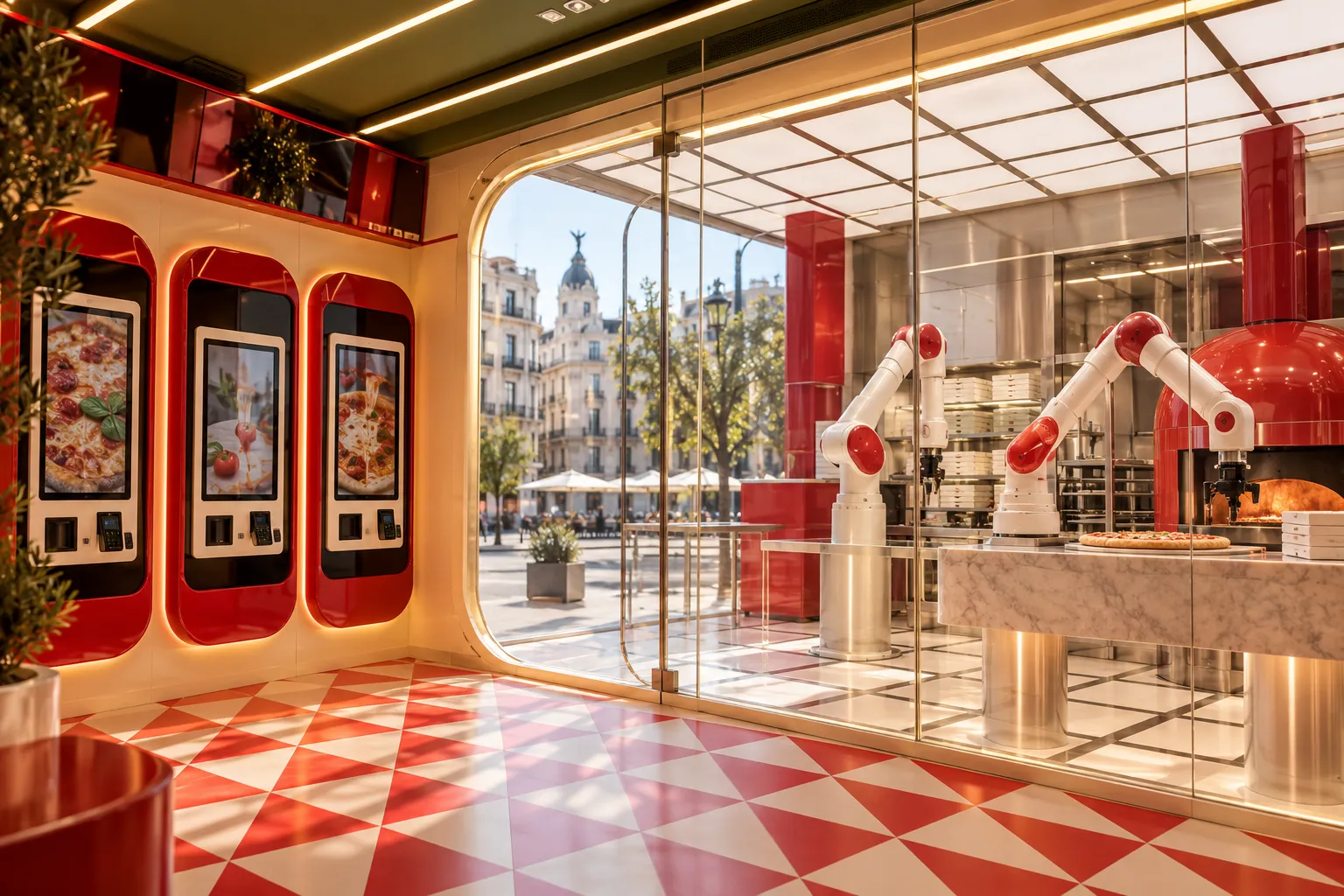
PAZZI, the robotics-led pizza concept, has opened a fully automated pizzeria in Madrid, according to a report published by Startupticker.ch on 1 May 2026. The launch brings to the Spanish capital a format built around a robot that assembles and bakes pizzas with minimal human intervention, a category that has struggled to move from novelty to sustainable operation across Europe.
For Madrid's hospitality and tech operators, the arrival is a live test of whether food automation can work in a market defined by dense casual-dining competition and thin margins. The single source available confirms the opening and the automated nature of the site, but does not disclose the size of the investment, the location's expected daily covers, or the local partners behind the rollout. Those gaps matter, and they are stated here rather than filled with guesswork.
What did PAZZI actually launch in Madrid?
According to Startupticker.ch, PAZZI opened a fully automated pizzeria in Madrid, with the report dated 1 May 2026. The core of the concept is a robotic system that handles the preparation and baking of pizzas, reducing the kitchen headcount a comparable manual restaurant would need.
PAZZI originated as a Paris-based robotics venture, building its reputation on the claim that a machine could produce restaurant-quality pizza without a chef at the pass. The Madrid site is the newsworthy step because it moves that proposition into a second major European market and a second language of operation.
Beyond the fact of the opening, the source does not provide the figures a founder or investor would want: the capital committed to the Madrid launch, the projected throughput per hour, the price point per pizza, or whether the site is company-owned or run with a local franchise partner. Where those numbers are not attributed, they are not printed here. What is confirmed is narrow: a fully automated pizzeria, in Madrid, live as of the report's May 2026 date.
Why does an automated pizzeria matter in Madrid?
Madrid's casual-dining sector is crowded and price-sensitive, which makes it a demanding proving ground for any automation pitch. Labour costs and staff availability have been recurring pressures for restaurant operators across the city, and a format that shifts preparation to a machine speaks directly to that pain point. The question the market will judge is whether the unit economics of a robotic kitchen beat those of a well-run manual one once rent, maintenance and the capital cost of the machine are counted.
The opening also fits a broader pattern of international tech-led businesses choosing Madrid as an entry point into the Spanish market. The city has been absorbing new arrivals across software and consumer tech, with names such as Bending Spoons opens Madrid office in bet on Spanish tech talent signalling that Madrid is increasingly treated as a base rather than a satellite. An automated food concept is a different bet, tied to physical footfall and a specific site, but it draws on the same read of Madrid as a market worth committing to.
For local operators, the practical watch-item is simple: does the site draw repeat custom, or does the automation remain a curiosity that pulls a launch-week crowd and then thins out? That is the metric no press line can settle in advance.
How does this compare across Europe's food-tech scene?
Food automation has advanced unevenly across the continent. Robotic and heavily automated hospitality formats have appeared in several European cities, but few have demonstrated durable, scalable economics, and some high-profile efforts have retrenched. PAZZI's move into Madrid is therefore best read as an expansion test rather than proof that the model has been solved.
The wider European tech story around these six cities remains dominated by software rounds and platform plays, from Paris event platforms to Milan-headquartered app owners planting flags in Spain. A hardware-and-real-estate concept like an automated pizzeria carries a heavier cost base than a software launch, which is precisely why the undisclosed investment figure is the number that would most change how operators and investors read this. Until PAZZI or a credible outlet publishes throughput and cost data, the Madrid opening is a signal of intent more than a benchmark.
What to watch next
The immediate milestone is operational: whether the Madrid site holds custom beyond its opening weeks and whether PAZZI publishes any performance figures, covers per day, average ticket or staffing, that would let the market judge the model. A second Spanish location, or a stated franchise plan, would be the clearest sign the company sees Madrid as a base for wider expansion. For now, the confirmed facts are limited, and the most useful reporting will be the numbers PAZZI has not yet released.