Elevating Business Agility Through LEGO® SERIOUS PLAY®
In today’s business ecosystem, characterized by volatility and technical interconnection, the concept of Business Agility has evolved from an aspiration into a survival necessity. It is not merely about reacting quickly, but about cultivating an organizational mindset focused on results through radical collaboration.
The recent workshop held by the DMK Tribe community, led by expert Andrea Romoli, shed light on an uncomfortable truth: traditional decision-making methods are reaching their effectiveness limits when faced with complex problems. The solution, paradoxically, lies in a return to the tangible through the LEGO® SERIOUS PLAY® (LSP) methodology.
The Complexity Crisis and the Agility Imperative
The starting point of the session was an analysis of the current landscape. In highly competitive markets such as Lisbon, Barcelona, or Milan, leaders face challenges where the "best practices" of the past no longer guarantee future success. Romoli emphasized that business agility is the vehicle to ensure that every team member not only contributes but also feels shared ownership over the generated solutions.
Agility, in this sense, is not a rigid recipe but an experimental framework. In complex environments, leadership must transition from hierarchical control toward facilitating environments where practices emerge organically from learning after failure. This transition requires a foundation of trust and commitment that conventional meetings often fail to build.
LEGO® SERIOUS PLAY®: Beyond the Post-it
One of the fundamental technical premises discussed was the limitation of traditional visual tools. While post-its and digital boards are valuable for task organization, they often lack the three-dimensionality necessary to represent complex systems or deep emotional dynamics.
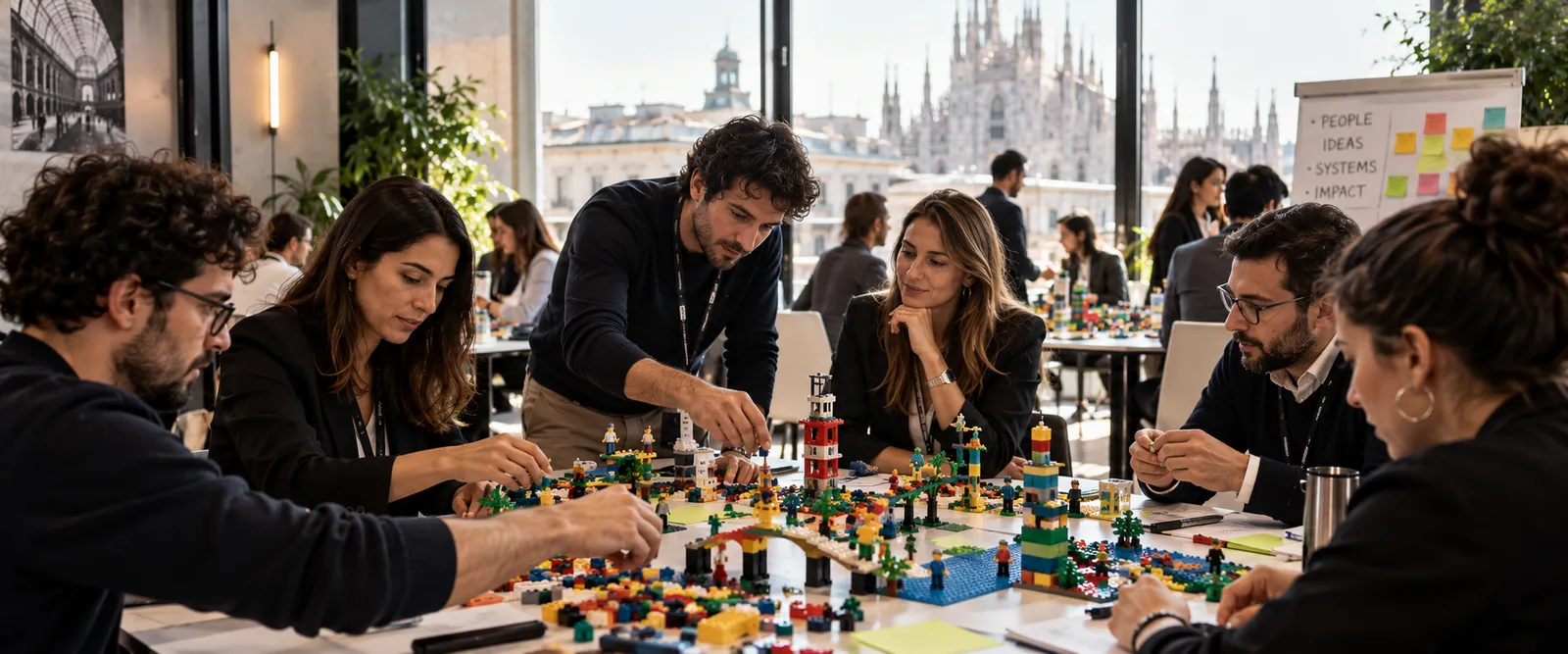
The LSP methodology, originally developed by Robert Rasmussen and Per Kristiansen for the LEGO Group, is based on the concept of "hand-knowledge." During the workshop, we analyzed how building 3D models acts as a neurophysiological bridge:
- Metaphorical Thinking: Every brick and figure becomes a metaphor for abstract concepts (strategy, risks, market relations). By assigning meaning to a physical object, the brain processes information more deeply and durably.
- Externalizing Thought: By building, "invisible" thoughts become tangible. This eliminates ambiguity in team communication; discussions are no longer about an abstract idea that everyone interprets differently, but about a physical model present on the table.
- Democratizing the Voice: LSP guarantees that 100% of participants contribute equally. In a standard debate structure, dominant personalities often overshadow the rest. Here, the model is the protagonist, allowing even the most reserved profiles to provide critical solutions.
Building Strategy in Real-Time
The technical core of the session focused on how to apply this tool for Real-Time Strategy. Unlike five-year strategic plans that become obsolete a month after their creation, strategy under Andrea Romoli’s approach is dynamic. The key steps identified are:
- Challenging the Problem: The facilitator poses a question that has no obvious answer, forcing the team to delve into the core of the issue.
- Individual Construction: Each participant builds their own model. This process fosters technical introspection and individual problem-solving before group convergence.
- Sharing Meaning: The story of the model is narrated. Storytelling makes it easier for the team to understand the internal logic of each proposal without external judgment.
- Creating Systemic Landscapes: Individual models are integrated into a larger system representing the organization's reality, allowing for the identification of connections, bottlenecks, and opportunities that were previously invisible.
This process of "making the invisible visible" is what allows organizations to achieve superior speed and effectiveness. Implementation becomes faster because alignment does not occur after the meeting, but during the very creation of the model.
The Return to the Tangible
Building Strategy in Real-Time
During the debate generated within the DMK Tribe, the collective conclusion was clear: the biggest barrier to innovation is not a lack of technology, but a lack of trust and analysis paralysis. Participants highlighted that using methodologies like LSP acts as a catalyst for psychological safety.
The group consensus emphasized that by focusing attention on the built model and not on the person who built it, the fear of criticism is reduced. This allows disruptive ideas to flow without the filter of professional self-censorship. The collective intelligence of the community validated that business agility is, ultimately, a matter of trust and emotional alignment toward a common goal.
In conclusion, the session with Andrea Romoli reaffirmed that to navigate global market uncertainty, leaders must be willing to abandon flat tools in favor of multidimensional approaches. LEGO® SERIOUS PLAY® is not a game, but a rigorous process of systems design and corporate strategy.
Implementing these insights into daily professional life implies accepting that the most robust solutions are those built by the collective, where creativity is used as a technical language to articulate the future of the organization. For the modern professional, developing this creative confidence is the definitive step toward genuine and sustainable business agility.
Andrea Romoli
A seasoned facilitator in Design Sprint, LEGO® SERIOUS PLAY®, and Design Thinking processes.
Laura Gruich
Team & Leadership Facilitator | LEGO® SERIOUS PLAY®
Elena Stivali
Maieutic Facilitator, certified in the LEGO® SERIOUS PLAY® Method
This piece was first published in DMK Tribe Magazine, issue 19, written by the DMK Tribe community after the workshop it reports on.